
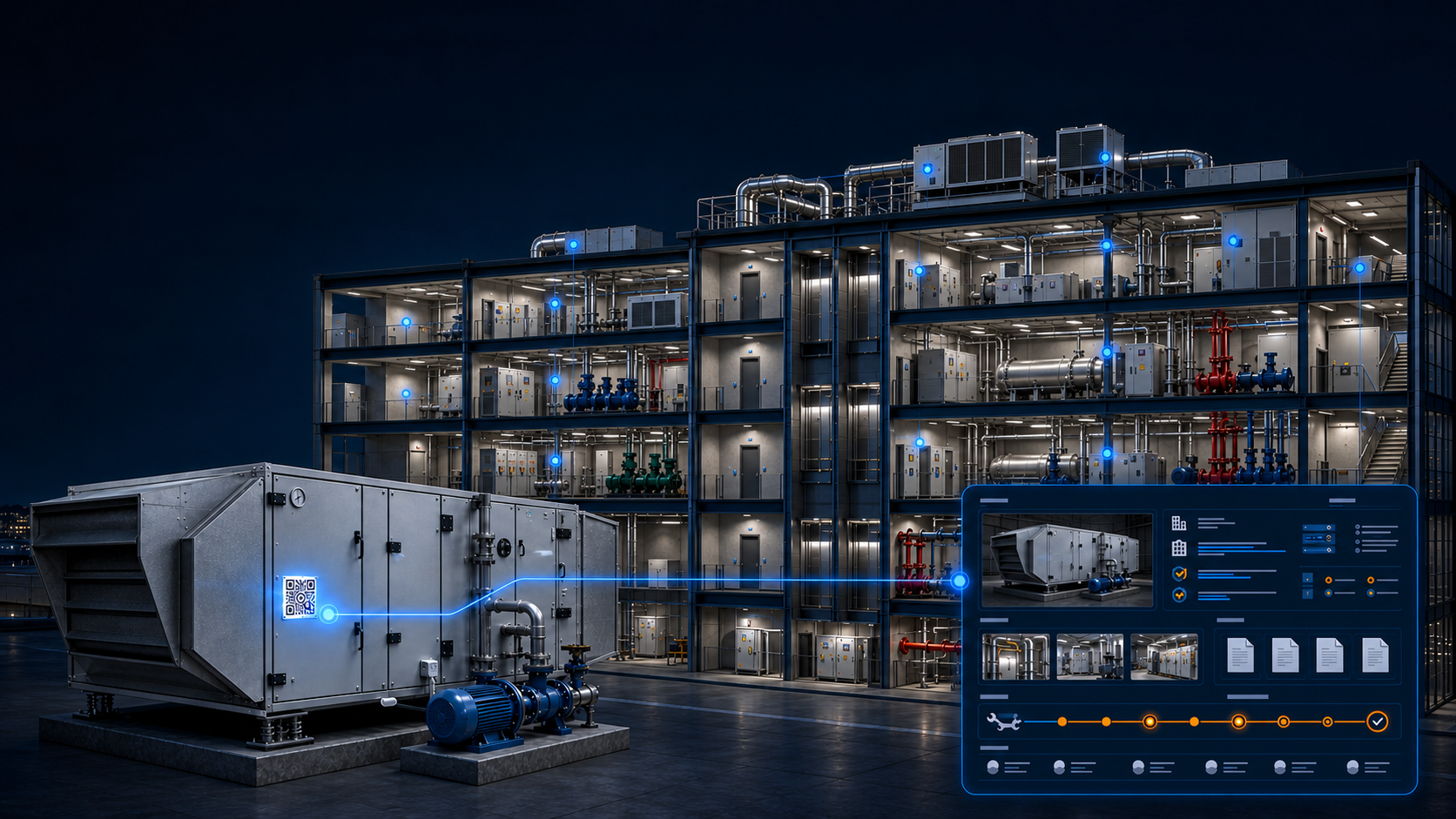
BEYOND THE LABEL
Putting a QR label on equipment is easy.
Keeping that label connected to the right physical asset, the right approved documents, the right installation evidence, and the right history for the next twenty years is the hard part.
This is why Asset Intelligence cannot begin and end with a code generator. A scan should not merely open a web page. It should resolve a persistent identity and tell the user what is known, where that knowledge came from, and whether it has been validated.
The QR code is the doorway. The governed asset record is the product.
PERSISTENT IDENTITY
Identity must survive changing information.
Equipment names change. Locations are reorganized. Customer tags are revised. Manufacturers discontinue models. Documents move. Software platforms are replaced.
The asset still needs to remain the same asset.
A durable system separates permanent identity from changeable information. Each tracked object receives one stable, opaque identifier. Human-readable names—“Panel LP-2,” “AHU-4,” “Pump P-101”—remain useful aliases, but they are not the permanent key.
This design principle appears in mature identification standards outside construction. GS1's resolver standard distinguishes the identity of an entity from the changing online information connected to it; the destination can be updated without reprinting the identifier. Frontier applies the same architectural lesson to customer-controlled construction and facility records, without implying that every implementation must use GS1 identifiers or public web resolution.1
For Frontier Asset Intelligence, the QR code contains only an opaque identifier or safe resolution token—not confidential project information. The useful data remains in the customer-controlled record and can remain resolvable locally when internet access is unavailable.
FIELD VALIDATION
A scan is not validation.
A QR code can confirm which digital record was requested. It cannot, by itself, confirm that the label is on the correct equipment, that the serial number was entered correctly, or that the attached document reflects the installed condition.
Validation still requires evidence and authority.
At installation, a field workflow might connect the asset identity to its location, serial number, photographs, delivery record, installer, inspection, startup result, and commissioning status. A responsible person reviews consequential changes before they become authoritative. Later activity—maintenance, warranty work, deficiencies, replacements, and approved modifications—extends the same history rather than creating disconnected records.
Identity → observation → evidence → review → approved record → continuing history
That sequence prevents a convenient scan from becoming false confidence.
ONE OBJECT, TWO VIEWS
One asset needs technical and commercial memory.
Most asset registers focus on what the equipment is. Construction businesses also need to remember how it became real.
The technical view may include manufacturer, model, capacity, voltage, specifications, serial number, condition, commissioning, maintenance, and operating history. The commercial view may include estimated cost, vendor quote, purchased cost, freight, lead time, labor hours, change impact, warranty cost, and eventual replacement cost.
Those should not become separate identities. They are governed views of the same object.
That connection is commercially important because a physical asset begins long before a serial number is known. It may first appear as an asset type in a specification, then as a planned group measured from drawings, then as a procurement lot covered by a vendor quote, and finally as one or more installed instances.
Preserving that lineage allows a future estimator to understand more than what a replacement cost today. The company can learn what was carried, what was quoted, what was purchased, what was installed, how much labor it required, and what happened in service.
CONTINUOUS HANDOVER
The market is moving toward continuous asset records.
The construction software market is beginning to treat handover as a process rather than a final upload. Procore's August 5, 2026 Asset Register announcement describes field updates through scannable QR codes, an audit trail from installation through handover, and structured exports for owner maintenance systems. Those are Procore's product claims, but the workflow direction is significant: asset information is being captured and validated while construction is underway instead of reconstructed at closeout.2
Frontier's thesis goes further upstream.
The strategic advantage is not a longer equipment list. It is the technical and commercial thread connecting drawing, quantity, estimate, quote, procurement, field installation, actual performance, and future estimate.
THE PHYSICAL INTELLIGENCE LOOP
The physical world can become part of the Intelligence Loop.
Asset Intelligence is a suite-wide architectural direction for Frontier today and a fuller product capability on the roadmap. The foundation is being designed now: persistent identity, governed relationships, immutable provenance, portable exchange, offline resolution, and explicit human approval.
That foundation matters because a QR program built without it becomes another temporary index. Labels outlive URLs. Projects outlive subscriptions. Facilities outlive the software selected at turnover.
The better future is one where a technician can scan an asset and reach a trustworthy operating history; an owner can retain that record under its own control; and a contractor can learn from the asset's complete commercial and technical life.
The square on the label is small. The intelligence behind it can compound for decades.
EXPLORE THE FRONTIER INTELLIGENCE LOOP →Source notes
- GS1-Conformant Resolver Standard, accessed September 1, 2026.
- Procore Introduces Asset Register Within Asset Management, August 5, 2026.