

EVERY PROJECT LEARNS
Construction finishes with more intelligence than it started.
Someone learns which assumption in the estimate was wrong. Someone discovers the detail that made installation faster. A superintendent remembers the sequence that avoided a shutdown. A technician finds the real reason a piece of equipment kept failing. A project manager learns which early warning mattered—and which one was noise.
Then the project ends.
The people move on. The drawings go into a folder. The final costs settle into a report. The lessons survive unevenly—in a spreadsheet, a closeout package, a meeting note, or the memory of someone who may not be on the next job.
The industry does not lack intelligence. It loses continuity.
That is where the most promising future for artificial intelligence begins.
BEYOND SPEED
The opportunity is bigger than automation.
Most conversations about construction AI begin with speed: produce a takeoff faster, summarize a document faster, answer a question faster. Those gains matter, but they are only the surface.
The deeper opportunity is to connect the decisions made across the life of a project so that knowledge can compound.
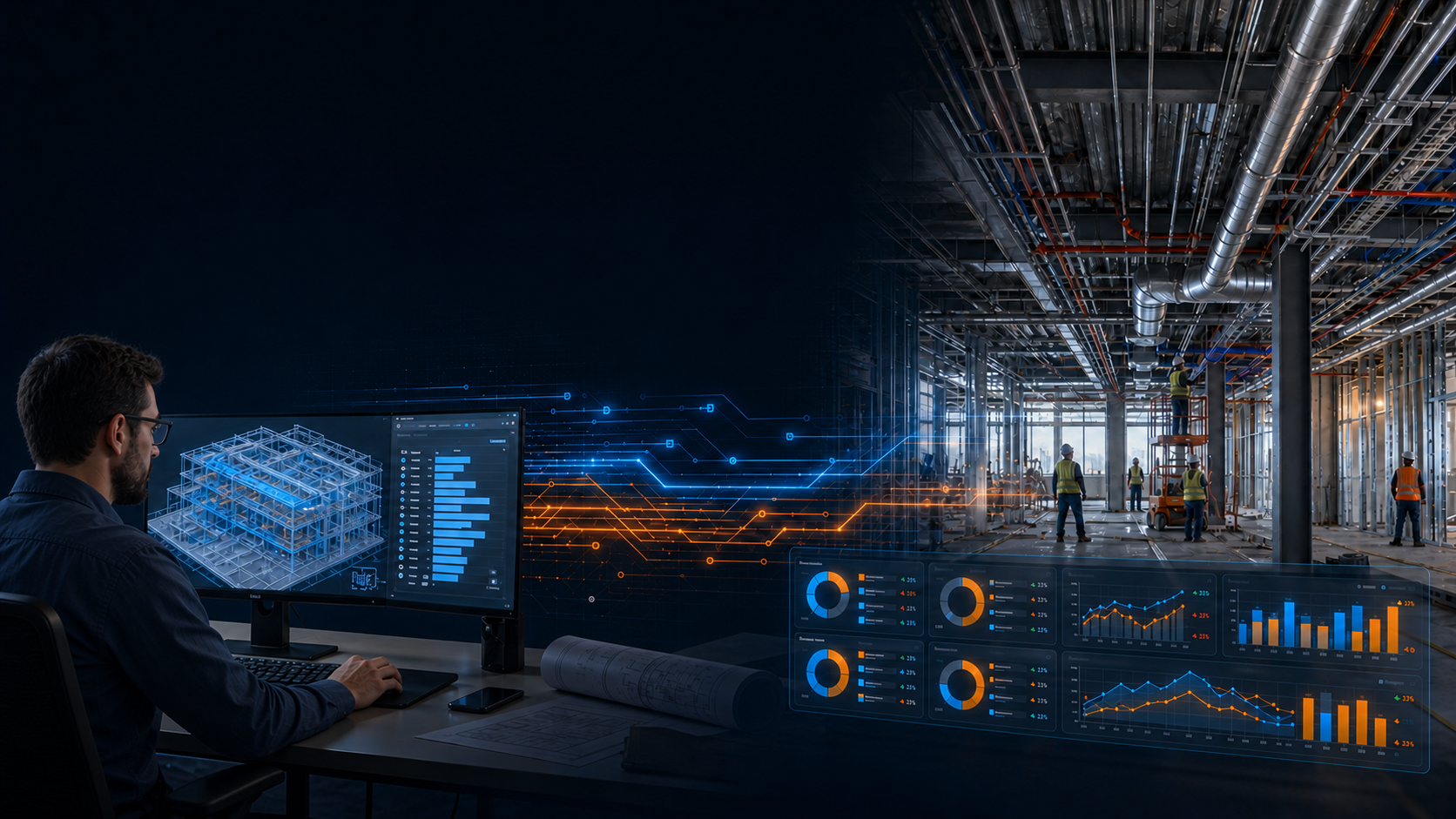
Imagine an estimate in which every important quantity still knows where it came from. A field observation can reconnect to the drawing, assumption, location, and scope it affects. A variance can explain not only that the project missed, but why. A turnover document can become a practical interface for the people operating the facility. An installed asset can retain its identity, history, and relationships long after the original project team leaves.
None of this requires removing people from the process. It requires giving people better continuity.
COMPOUNDING EXPERIENCE
A project should be a teacher.
Today, many companies begin each project with experience—but not with the full evidence of their experience.
The next estimator may know that a previous job had problems without seeing the exact assumption, condition, or decision that caused them. The field may receive a budget without the reasoning behind it. The facility team may inherit accurate records without an efficient way to use them.
AI can help transform that fragmented history into usable context. It can organize, compare, retrieve, connect, and flag. It can bring the right record forward when a decision is being made. It can reveal patterns that are difficult to see across thousands of documents and years of work.
But the objective should not be a machine that claims to know everything. The objective should be a system that helps people see what the organization already knows—and understand why it knows it.
That distinction matters.
A fluent answer can still be wrong. A useful answer should be connected to evidence. It should show the drawing, photograph, field note, quantity, revision, or asset history behind it. It should make uncertainty visible. And when a decision carries consequences, a responsible person should remain in control.
AN OPTIMISTIC FUTURE
The future can be more human, not less.
There is a reasonable fear that AI will flatten skilled work into generic automation. Construction should move in the opposite direction.
The best systems will make expertise more visible and more valuable. They will preserve the judgment of experienced people without pretending that judgment can be reduced to a prompt. They will remove hours spent searching, re-entering, comparing, and reconstructing so that people can spend more time planning, coordinating, building, troubleshooting, and deciding.
This is an optimistic future because it does not depend on perfect automation.
It depends on practical progress: one source-linked quantity, one reviewed field observation, one explained variance, one interactive document, one connected asset, and one retained lesson at a time.
Each connection makes the next decision better. Each completed project strengthens the next estimate. Each resolved problem becomes part of the organization's operating memory instead of disappearing into the past.
CUSTOMER-OWNED KNOWLEDGE
Intelligence should compound for the customer.
There is one condition that will determine whether this future genuinely benefits contractors and owners: the intelligence created from their work must remain theirs.
Drawings, quantities, field records, cost history, facility documents, and operating knowledge are not disposable inputs. Together, they form a competitive and operational asset.
Companies should not have to surrender control of that asset to gain the benefits of AI. Local, on-premises, edge, and selectively connected systems can all play a role. The right architecture will depend on the work, but customer ownership, traceability, and human authority should not be optional features.
This is the direction Frontier Intelligence is being built toward: not a single machine making every decision, but a connected operational thread that helps people carry knowledge forward.
THE NEXT PROJECT
What if every project made the next one smarter?
The most important construction AI may not be the system that speaks the loudest or appears the most autonomous. It may be the one that remembers accurately, shows its work, and helps the next person make a better call.
It can.
Keep your data. Unlock the intelligence.
EXPLORE THE FRONTIER INTELLIGENCE LOOP →